I Spent 9 Years Thinking I Was Broken — Until a 5-Minute Daily Method Rewired My Body in 14 Days and Gave Me Back the Confidence I Had Lost in the Bedroom

If you have ever been with a woman — and it ended before you wanted it to — read every word on this page.
If you have stared at the ceiling afterward. Rehearsed a quiet apology you never said out loud. Told yourself it was just stress, just that night, just the position — read this.
If you have started avoiding intimacy altogether because you already know how it ends — read this especially.
You have tried things. The delay spray from the pharmacy near your office. The “performance” capsules someone swore by. The condom with the special coating that made everything feel distant and strange. The breathing exercises from an article you found at midnight.
Maybe you tried the squeeze technique. You read about it three times. It didn’t work the way it was described. You blamed your focus.
Maybe you have tried going again — believing the second round would fix it. Sometimes it did. Mostly it didn’t.
None of it was sustainable. None of it changed anything at the root.
And the worst part is not the problem itself.
The worst part is what it does to the space between you and the woman you love.
The look that crosses her face before she can control it. The silence that settles in after. The careful, polite distance that grows — slowly, then suddenly — until you are sharing a bed but not really sharing anything.
You stop reaching. She stops asking. You both pretend you haven’t noticed.
That is not a performance problem. That is a life erosion problem. And no spray, no pill, no article, no late-night forum has ever told you why it keeps happening — or what is actually creating it.
“I know. Because I carried it too — for nine years longer than I should have.”

My name is Afini Preye.
I am not a doctor. Not a urologist. Not a therapist. I am just a man from Yenagoa, Bayelsa State, who spent the better part of nine years inside this problem — confused, ashamed, and spending money on things that treated the symptom while the cause kept running underneath everything.
I grew up in a house where nothing personal was discussed. Sex education in school was a chapter nobody explained. Everything I ever learned about my own body — I learned alone. In secret. As fast as possible.
I was twenty-seven when I got married. I loved my wife immediately and completely. But the bedroom became something I feared from almost the beginning. The pattern was consistent: two minutes, sometimes three, then the familiar weight of failure settling in.
I spent money I didn’t have. ₦40,000 on a supplement a colleague swore by. It gave me a headache and nothing else. ₦18,000 on a numbing spray that removed all sensation for thirty minutes — including any desire to continue. ₦22,000 on an online course with confusing diagrams and no cultural relevance. I didn’t finish the second module.
I went to a doctor. He was polite. He printed a sheet about performance anxiety and said stress was likely a factor. He did not ask when I first learned to masturbate. He did not ask about the years of secretive, hurried practice. He did not ask what I had been conditioning my body to do since I was fourteen.
Nobody ever asked that question. Not once.
My wife and I stopped fighting about it eventually. The fighting had stopped because something quieter had replaced it. A careful management. Two people in the same house, both pretending the distance was normal, both too exhausted to name what was eroding between them.
At thirty-four, I had accepted that this was simply the shape of my life. I had run out of things to try and run out of hope that anything would be different.

The discovery did not happen in a clinic. It did not happen online.
It happened during the annual end-of-year visit to my father’s compound in Rivers State — the gathering where the whole extended family comes together, the older men sit under the trees, the women organise food from morning until dark, and the children run until their legs give out. The kind of visit that feels both chaotic and deeply grounding. The kind that reminds you where you come from.
My father’s oldest friend, a man the whole compound called Papa Tamuno, lived nearby. He was in his late seventies. Former teacher, former community health volunteer from the era before the hospitals arrived. He still carried himself with a quietness that made you want to listen. His wife, Mama Tamara — a short, round woman with sharp eyes and a voice that could fill a courtyard — had been a traditional birth attendant for nearly forty years. Between them, they had seen most things a body could do and most things a person could suffer.
On the second evening, Papa Tamuno came to sit with us after dinner. I was quieter than usual. My wife had gone inside early. There had been an incident the night before — the familiar pattern — and the weight of it was showing on my face in ways I couldn’t hide.
Papa Tamuno watched me across the compound for a long time. Then Mama Tamara appeared beside him, looked at me, and the two of them exchanged something in a glance that contained more diagnosis than any doctor’s appointment ever had.
I have never felt more seen — and more exposed — in my life.
The Morning That Changed Everything

Papa Tamuno came to find me just after six the following morning. I was sitting alone near the back of the compound, pretending to look at my phone. He sat down beside me without ceremony.
He poured tea from a flask he had brought. He did not make it dramatic. He simply began to speak the way old men speak when they are not performing — slowly, with the confidence of someone who does not need you to be impressed, only to hear.
“You were never defective. You were simply never taught.”
Nine words. I had to sit with them for a moment before I understood what they cost him to say and what they gave me to receive.
I am not ashamed to tell you that I wept. Not loudly. The quiet kind — the kind that happens when you have been carrying something heavy for years and someone finally holds out their hand. Not to take it from you. Just to acknowledge its weight.
“You young men, you run to the pharmacy, you buy this bottle and that capsule, you order things online with your phone — all treating the outside. You are treating the smoke, not the fire. And because the fire is still burning, the smoke always comes back.
Our grandfathers’ time — men were not having this kind of problem the same way. Not because they were stronger men. But because they were not trained in hiding. They were not taught to finish before someone caught them. They were not sitting alone with bright screens, their body learning, every single day, that the goal is to arrive quickly. The body learns what you repeat. It does not know you are practicing privately. It simply learns the pattern.”
“What is happening inside you is not weakness. It is not your character. It is a conditioned reflex. Your nervous system — the wires that carry feeling from your body to your brain — they were trained to respond in one way. Fast. Urgent. Like something chasing you. And so every time stimulation begins, the system runs the old programme: accelerate, complete, finish.
It is like a driver who only learned to press the accelerator and was never taught the brake or the middle speed. The car is not broken. The driver was never taught the full range.”
Your body has a natural arousal regulation system. A built-in range — from calm to climax — with multiple stages between them. When that system is trained correctly, through slow and deliberate repetition, your body learns to recognise each stage and regulate itself at will.
But when the system is trained only by urgency — by years of rushed, secretive practice designed for speed — it adapts. It learns to skip the middle stages entirely. It learns that the goal is the finish, and it begins executing that programme automatically every time, without your permission.
This is not a defect. It is conditioning. The nervous system learned a shortcut, and it now takes that shortcut reflexively. Everything you have tried to stop it — willpower, distraction, sprays, supplements — was fighting the symptom, not the source.
The real issue was never what was happening in the moment. The real issue was the pattern that had been built silently, over years, through every rushed and secretive session. And a pattern that was trained can be retrained.
“It is not recurring. It is being recreated.”
Six words. I replayed them fifty times before I reached my father’s compound that morning.
All those years. All that money. All those nights of quiet shame. And not once — not by any doctor, not by any article — had anyone asked how the pattern started. What had been taught. Whether it could be untaught.
It took two people, in a quiet compound in Rivers State, to tell me what was actually happening.
The method Papa Tamuno and Mama Tamara described was not complicated. It is done alone, at home, in private. It takes ten to fifteen minutes. There is nothing to buy, nothing to insert, nothing to swallow, nothing to steam, nothing that requires anyone else to be present or to know.
It is a structured solo practice built around teaching your body to recognise arousal at its earlier stages — before the rush, before the loss of control — and to stay calmly in those earlier stages until you choose to move. Repetition does the work. The nervous system learns the new pattern the same way it learned the old one: through consistent, deliberate practice.
“Follow the sequence exactly as it is written. No shortcuts. Your body is not in a hurry — you are the one who taught it to hurry. You must now teach it that there is no rush. And when you feel the difference — when you notice that you are somewhere you have never been before — just smile. Don’t make noise about it. Just smile.”
The First Few Days: Nothing
Day 1. I started the sequence that evening while my wife slept. Nothing remarkable happened. I felt self-conscious. I second-guessed the technique. The whole exercise felt clumsy and uncertain.
Day 2. Slightly more awareness. Perhaps. I noticed a moment where my breathing changed and I caught it consciously. Or I thought I did. I could not tell if I was genuinely noticing something new or constructing the memory I wanted.
Day 3. I almost stopped. Long day. I was tired and the voice in my head was running its familiar script: this is another thing that will not work, you are wasting your time, there is nothing to fix. I remembered what Mama Tamara said about patience being part of the method, not separate from it. I did the sequence anyway.
Day 4. Something small. During the sequence I caught myself at a point I can only describe as “earlier than usual.” Not the edge. The approach to the edge. A moment I had never consciously noticed before. It was brief. But it was new. And it was mine.
Day 5: The First Sign
Day 5 produced something real.
There was a distinct moment during the sequence — clear, unmistakeable — where I felt the arousal beginning to climb and instead of the familiar rush past awareness straight into urgency, I felt it arrive in stages. Like steps I had always been taking too fast to notice.
I slowed. I breathed the way the method described. The urgency did not disappear. But it paused. And in that pause I understood something I had never understood before: there was space there. Real, inhabitable space. Space I had been running through my entire adult life without knowing it existed.
Day 6. Day 7. Then Something Broke Open.
Day 6 the recognition came earlier. Day 7 I held the pause longer. By Day 8 something in the fundamental pattern had shifted.
I know this because of one detail I have told only a few people. A detail that still moves me when I think about it clearly.
For nine years, the first thing I thought about every single morning — before the tea, before the news, before anything — was the problem. Some version of dread. Some version of will tonight be the same.
On Day 8, I woke up and made tea and sat with the window open and read for an hour. And it was not the first thing in my head. It was not even the second. It arrived later, almost as an afterthought, and when it did — it arrived without the weight it had always carried before.
“For nine years the dread was the first thought every morning. On Day 8, I forgot it was there. That forgetting — that ordinary, unremarkable forgetting — was the proof.”
But the real test was yet to come.
Friday Night
It was the second Friday after returning from my father’s compound.
My wife reached for me in the way she had stopped reaching — the way that says I want you, not I am trying again. The way that had disappeared quietly some years before and that I had stopped expecting to return.
I did not go rigid. I did not begin the mental rehearsal — the calculations, the distractions, the silent apologies prepared in advance. I stayed present. I felt the arousal begin to climb and I recognised it. Level 2. The beginning of Level 3. The approach. I breathed. I stayed. I moved with it instead of against it.
I have no number to give you. That is not what matters. What matters is this: my wife looked at me afterward in a way she had not looked at me in years. She put her head against my chest and she said something quiet that I will not repeat here. It was only for us.
I held her and I let myself feel what I felt. Not shame. For the first time in nine years, what I felt afterward was not shame.
“She held me the way a woman holds a man she has been waiting for. Like I had finally come back from somewhere she had been afraid to ask about.”
I Did Not Plan to Tell Anyone
I told one person. My cousin Tonye, who had once made a joke about this kind of thing — the way men joke when they do not know how to say what they actually mean.
I told him what I had done. Not all of it. Enough. He listened in the specific silence of a man who recognises something in what you are describing. Then he said: “Send me what you have.”
Three weeks later he called from Port Harcourt at nearly midnight. He did not say much. He just said: “Brother. You changed my life.”
From there it moved the way things move between men who trust each other: quietly, carefully, through voice notes and private messages, one man passing it to the next. No announcements. No broadcast. Just one man telling another: this one is different.
By the time I decided to document everything Papa Tamuno and Mama Tamara had taught me — to write it out properly, with the science, with the sequence, in plain and mature language — I had already heard from men in Lagos, Abuja, Kano, Enugu, Benin City, Calabar. All carrying the same weight. All saying the same thing: nobody ever explained this to me before.
“Nine years. I tried everything. I was genuinely about to give up on my marriage. The Arousal Ladder framework is the first thing that gave me real language for what my body was doing. By Day 10 I was a different man. Not an exaggeration. My wife has noticed and she doesn’t know what changed. I know.”
“I bought thinking it would be the usual rubbish. It was not. The Dopamine Spike Trap section alone explained ten years of confusion in three pages. Week 3 of the sequence. The control I have now compared to one month ago is not small. It is significant.”
“The part about how we were trained — secretly, quickly, from a young age — that was my exact story. Nobody ever connected those two things for me before. Nobody said: this is what you taught your body and this is how you unteach it. This guide said it plainly. Without shame. Then gave me a real method.”
“Forty thousand naira on supplements over two years. Nothing worked. I paid less than ten thousand for this guide and in two weeks had results those supplements never gave me. ‘It is not recurring, it is being recreated’ — I sent that line to my brother in London. He said the same thing I said: why has nobody told us this before.”
“As a Muslim man I was ashamed to search for this kind of help. The way this guide is written — calm, respectful, no obscene language — I could read it like a health textbook. It treated me like an intelligent adult. The method is practical. The results are real. I have told my younger brother.”
“Twenty-six and I thought I was the only young man with this problem. Hearing that it is conditioning — not weakness, not character, conditioning — was genuinely healing for me. Three weeks in. Real change. This is the one that actually works.”
Same method. Same sequence. Same Arousal Ladder. Same results.
Why I Am Sharing This
I went back to Rivers State at Christmas. I sat with Papa Tamuno and Mama Tamara under the mango tree. I told them what had happened — with me, with my wife, with the men I had shared the information with.
Mama Tamara laughed first. A deep, full laugh. Papa Tamuno smiled slowly in the way of men who are unsurprised by good news they expected all along.
I asked them: can I write this down properly? Can I document it — add the science, use the clinical language, make it available to men who will never sit in a compound in Rivers State and hear it from someone who loves them enough to say it plainly?
Mama Tamara looked at me for a moment. Then she spoke.
“Do it. Write it with respect and write it with clarity. No shame in it, no vulgarity in it — just the truth, plainly said, to men who deserve to understand their own bodies.
And make sure every man who reads it understands one thing completely: they were never broken. They were never weak. They were never less than any other man. They were simply never taught. And there is a very important difference between those two things.”
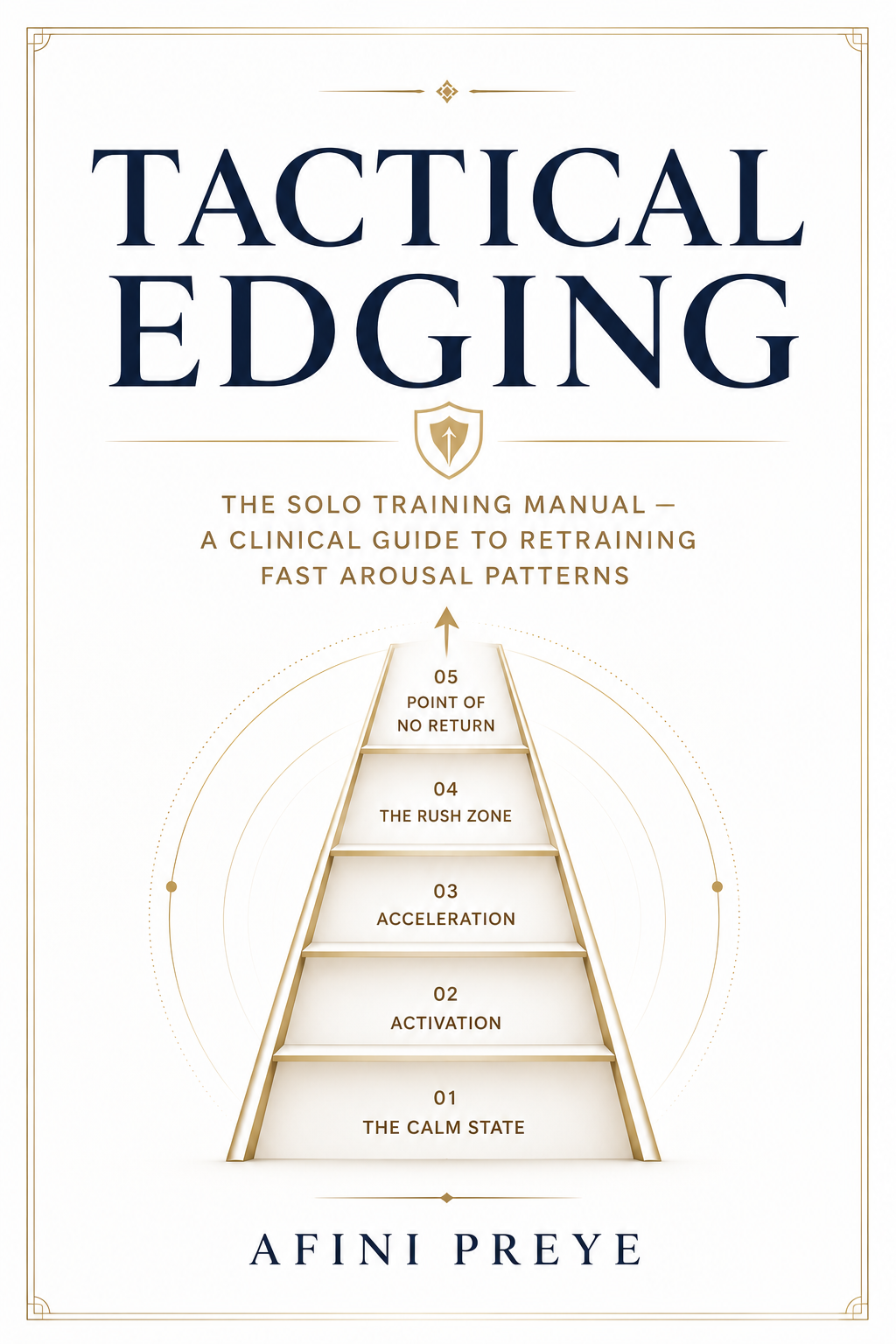
Everything Papa Tamuno and Mama Tamara taught me — documented, verified by a clinical consultant, written in plain and mature language — so you can begin the retraining process tonight, in the privacy of your own home, with no equipment, no prescription, and no one needing to know.
- The Arousal Ladder Method™ — The complete five-level framework for recognising and regulating your arousal response. Learn to detect and inhabit Levels 2 and 3 before your body rushes to Level 5. This is the foundation of the entire system. (Pages 8–21)
- The 14-Day Solo Training Sequence — Exact daily steps, duration, technique progression, and weekly markers. No guesswork. No vague instruction. Follow exactly as written. (Pages 22–41)
- The Dopamine Spike Trap — Explained — How years of high-intensity, high-urgency stimulation conditions the brain to chase rapid release, and the specific pattern-interrupt techniques that begin dismantling that conditioning at the root. (Pages 14–17)
- The #1 Mistake Men Make During Retraining — The anxiety loop that accelerates the very reflex you are trying to control, and how to break it before it starts. This single section has changed outcomes for dozens of men. (Page 18)
- Breath Override — The Underestimated Tool — How breathing rhythm directly influences your nervous system arousal state, and the precise technique used at each Ladder level to slow and redirect escalation. (Pages 29–33)
- The Pelvic Clench Awareness Protocol — Most men do not know their pelvic muscles are unconsciously tensing and accelerating the reflex. This section teaches you to detect, name, and release that tension before it takes over. (Pages 34–37)
- Food, Lifestyle & Recovery During the 14 Days — What to eat, avoid, and adjust to support nervous system regulation during retraining. Ordinary Nigerian food. No supplements required. (Pages 42–47)
- Extended Protocol for Severe Conditioning — For men who have been dealing with this for ten years or more. A modified 28-day sequence with additional recovery markers and patience checkpoints. (Pages 48–55)
You do not need to travel anywhere. You do not need to visit any clinic or speak to anyone. Every element of this method is done privately, at home, by you, alone. Total cost of materials? Nothing. Everything you need — you already have.
Compare That to What You Have Already Been Spending
- Pharmacy supplements and “stamina” capsules — ₦8,000–₦45,000 per cycle. They do not address the neurological pattern. When you stop, the pattern returns immediately. Nothing was retrained.
- Delay sprays and coated condoms — ₦3,500–₦12,000. They remove sensation rather than build control. The intimacy suffers in a different way. You finish later but feel less of everything.
- Online courses and “performance programs” — ₦15,000–₦60,000. Most are written for a Western audience with no understanding of how Nigerian men were introduced to sexuality. Generic advice that misses the cultural and psychological root entirely.
- Hospital and clinic consultations — ₦10,000–₦30,000 per visit. Most GPs will offer a pamphlet about anxiety. Very few are trained in sexual performance neuroscience. They treat what they can see. They do not ask about conditioning history.
- The internet search at midnight — Free in cost. Enormously expensive in time, confusion, and — for many men — in exposure to content that worsens the conditioning it claims to fix.
- The real cost — the one nobody puts a number on: the relationship damage. The careful silence. The partner who stops reaching. The version of yourself you stopped believing in. That cost has no figure. But you already know exactly what it feels like.
How Much Does This Guide Cost?
Let me show you what it took to create this properly — not as a sales argument, but because you deserve to understand the value of what you are receiving.
| Professional health copywriter and content researcher | ₦85,000 |
| Review and verification by clinical consultant | ₦40,000 |
| PDF design and layout (covers, formatting) | ₦25,000 |
| Testing with 30 men across 8 weeks | ₦18,000 |
| Website, hosting, and payment technology | ₦12,000 |
| Total production investment | ₦180,000 |
A fair price — even a fraction of what this took to build — would be ₦35,000. And compared to what most men have already spent on things that did not work, ₦35,000 would still be the wisest investment they ever made in themselves.
But I know how things are. I know what it is to spend money on hope and have nothing to show for it. So if you take action today —
Once You Click That Button, Here Is What Happens
- You are taken to a secure payment page. Simple, fast, and completely private. Your bank or card statement will show a discreet reference — nothing identifying or embarrassing.
- You complete your payment. Card, bank transfer, or USSD. Under two minutes from start to confirmation.
- Your guide arrives instantly — delivered directly to your WhatsApp and your email within 60 to 90 seconds of confirmed payment. You can be reading tonight.
It is me, Afini Preye. As long as your payment is confirmed, your access is 100% guaranteed — immediately, privately, tonight.
What Happens in the First 7–14 Days
Real conversations. Real men. Real results.
If you are one of the first 20 men to order today, you receive this bonus guide completely free:

A safety-first guide that explains clearly and honestly the real risks of pharmaceutical enhancers — including the ones sold at roadside pharmacies and in small sachets at motor parks. Then walks you through sustainable, natural biological alternatives that support arousal health, blood flow, and nervous system regulation using ingredients found in everyday Nigerian kitchens and local markets. No hype. No miracle claims. Just evidence-aligned information written with the same calm, mature tone as the main guide. This is what your pharmacist should have told you years ago.
Everything You Are Getting Today

- ✓Tactical Edging™ — The Solo Training Manual ₦35,000
- ✓BONUS: Beyond the Blue Pill — Natural Alternatives ₦20,000
Right Now, You Have Two Choices
If You Close This Page
- The pattern continues. Tonight, next month, next year.
- You keep spending money on things that treat symptoms.
- The distance in your relationship keeps growing quietly.
- You keep waking up with the weight as the first thought.
- Nobody explains what is actually causing it — because nobody has a reason to.
If You Start Tonight
- You understand — possibly for the first time — what this actually is.
- Within days you begin to notice your body differently.
- Within two weeks the pattern begins to change.
- Your relationship recovers something you stopped believing could return.
- You stop being a man who is afraid of his own body.
Guarantee
30-Day Money-Back Guarantee
Follow the Arousal Ladder Method exactly as written for 30 days. Do the sequence consistently — every day, as described. If at the end of 30 days you have seen no meaningful improvement in your awareness or control, send me a message and I will refund every naira. No complicated process. No interrogation. The method works. My confidence in it is what makes this guarantee possible.
One Last Thing…
Picture yourself one month from today.
Will you still be waking up with that familiar weight as the first thought of the morning? Or will you wake up as a man who has done something real and lasting about it?
Will you still be keeping your distance from the person you love — finding small reasons to stay tired, stay late, stay separate? Or will you be the man who came back to her?
Will you still believe, somewhere underneath everything, that something is permanently wrong with you? Or will you finally understand that you were never broken — just never taught?
Will you still be spending money on sprays and capsules that address the smoke while the fire keeps burning? Or will you have invested ₦9,500 in the thing that finally addressed the cause?
Will your relationship still be polite and carefully managed — two adults sharing space but not really sharing anything? Or will it be something real again?
Now picture yourself one month from today if you close this page right now. Nothing changes. The same pattern. The same mornings. The same distance.
“The difference between those two versions of you is a decision you make in the next sixty seconds.”
I Choose the Better Version — ₦9,500 →If you have read this far and you are still hesitating —
Ask yourself honestly: what is the hesitation actually about?
It is not about ₦9,500. You have spent more than that on things that did not work. You have spent more than that on things far less important than this.
The hesitation is about believing you deserve to fix this. It is about whether you believe you are worth the investment. Whether the version of yourself that is present, confident, and fully there for the woman you love — is worth ₦9,500 to create.
She has been patient. She has been quiet about things that hurt her. She has shown up for you. The least you can do is show up for yourself.
If you cannot invest ₦9,500 in your own control, your own confidence, your own marriage — how do you expect her to keep investing in you?
Stop hesitating. Choose yourself.
Choose Yourself — ₦9,500 →P.S. Your purchase is backed by a full 30-day money-back guarantee. Follow the sequence as written for 30 days. If you see no meaningful change, message me and I will refund you completely. No drama, no delay.
P.P.S. This guide is priced at ₦9,500 for the first 20 men only. That is not a marketing trick — it is the real operational limit. When those orders are filled, the price returns to ₦35,000. If you come back tomorrow, the offer may already be closed.
P.P.P.S. Every day you wait is another morning you wake up with the weight. Another evening of careful distance. Another version of yourself that never gets to exist. You have carried this long enough. Today is the day you put it down.
Afini Preye
Comments 1,847
Leave a Comment